Written by the workshop at Alan Dawson Autoworks & Recovery · Updated 31 July 2026
The first five minutes, in order
Work through these in sequence. The order matters more than the speed, because most breakdown injuries happen after the car has stopped, not during.
- 01 Get left, and get the hazards on If the engine is still turning, use the momentum to get onto the hard shoulder or as far left as the road allows. Hazard lights on straight away. If you are stopping in a live lane, leave the headlights on too so you are visible from behind.
- 02 Turn the wheels away from the road Point the front wheels towards the verge and leave it in gear with the handbrake on. If the car is nudged from behind, it moves away from traffic rather than into it.
- 03 Everyone out on the left, including the dog Get out through the passenger-side doors, never the driver side on a motorway. Take passengers and animals with you. Leave nothing in the car you would go back for.
- 04 Stand behind the barrier, up the road Get behind the barrier or up the embankment, and stand back from the car rather than in front of it, so a rear-end shunt does not reach you. On a motorway, do not put out a warning triangle: walking into a live lane is more dangerous than the car being unmarked.
- 05 Fix your location before you ring Look for the nearest motorway marker post, which gives the road number and the distance in kilometres, or the last junction sign you passed. On a back road, the Eircode of the nearest house or a phone map pin works fine. It is the single thing that decides how fast a truck reaches you.
- 06 Ring recovery, then stay put Give the location, the make of car, whether it is drivable, and whether it is on a hard shoulder or in a lane. Stay behind the barrier until the truck arrives. Do not accept help from anyone who pulls up uninvited on a motorway.
Should you stay in the car or get out?
On a motorway or dual carriageway, get out and stand behind the barrier. On a quiet road where you are well off the carriageway and visible, staying in the car with your seatbelt on is usually safer, especially in poor weather.
The hard shoulder is the most dangerous place on a motorway, because everything passing you is doing 100km/h or more and a stopped car is hard to judge. Getting out on the left and up behind the barrier takes you out of the path of anything that drifts.
On a rural road it flips. If you are pulled well in, the risk of being hit while standing on a narrow verge with no barrier can be higher than staying belted in. Use your judgement: if you can see a long way in both directions and you are properly off the road, stay put with the hazards on.
Either way, ring for help before you start diagnosing anything. If you are anywhere in Meath, Louth, Dublin, Westmeath or Cavan, our 24/7 breakdown recovery answers day or night.
Can you change a wheel on the hard shoulder?
No. Never change a wheel on a motorway hard shoulder, even if the puncture is on the passenger side. Ring for recovery instead. On a quiet road with a wide verge and good visibility it can be reasonable, if the flat is on the side away from traffic.
Kneeling beside a car on a hard shoulder puts your body inside the zone that a drifting vehicle sweeps through, and jacking the car takes several minutes during which you cannot move quickly. It is the single most common way people are hurt after a breakdown.
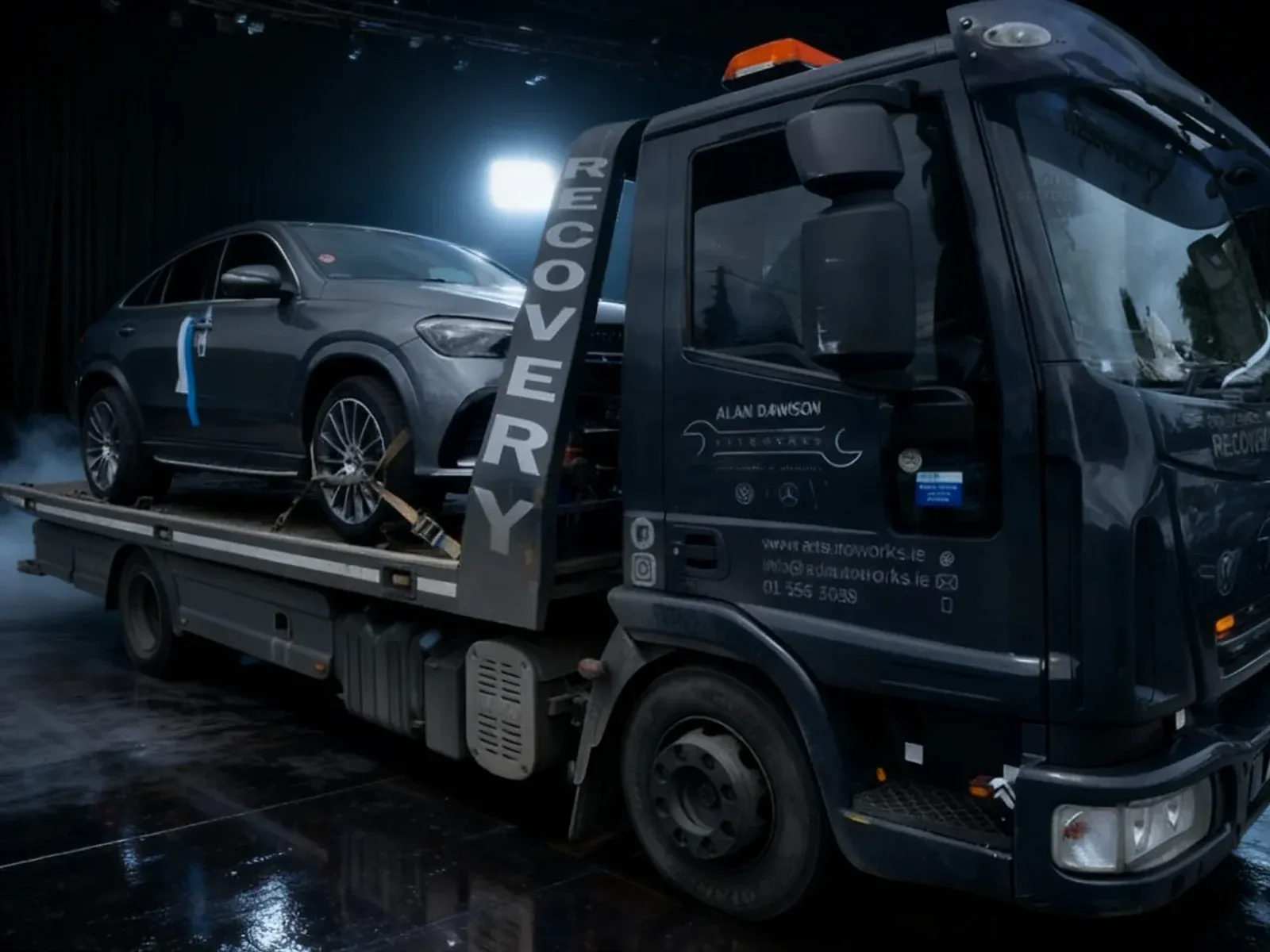
A recovery truck takes the car somewhere safe first and deals with the wheel there. That is the whole point of a flatbed: the problem gets solved off the road rather than beside it.
What information does the recovery driver actually need?
Your exact location, the make and model, whether the car still drives, whether it is on a hard shoulder or blocking a lane, and how many people are with you. Location is the one that decides everything else.
On an Irish motorway, the marker posts along the verge every 100 metres give the road number and the distance along it, and the arrow points towards the nearest emergency phone. Reading one out gets a truck to you far faster than "somewhere past the Ashbourne exit".
Off the motorway, an Eircode from the nearest house, a pinned location from your phone, or the name of the last crossroads all work. Tell us if the car is on a bend or over a crest, because that changes how the driver approaches and where the truck can safely stop.
Say straight away if the car is in a live lane rather than off the road. That changes it from a recovery job into an urgent one, and it changes who else needs to be told.
What does breakdown recovery cost, and what happens to the car?
It depends on distance, time of day and whether the car needs winching rather than driving on. We agree the price on the phone before the truck leaves, so there is no surprise at the roadside.
A flatbed lifts the whole car rather than towing it on two wheels, which matters for automatics, four-wheel drives and anything with low bodywork. It also means no extra wear on a gearbox that may already be the reason you stopped.
From there the car goes wherever suits: our workshop in Harristown, your own driveway, or a main dealer. If it comes to us, the same people who lifted it are the ones who diagnose it, so nothing gets lost in the handover.